Nikon Z 14-30mm f4 S review
Summary
 The Nikon Z 14-30mm f4.0 S is a compact extremist-wide tip over zoom designed for Nikon's full-frame Z-series mirrorless cameras. Like the standard f4.0 Z zoom, the Z 14-30mm f4.0 S employs a retracting mechanism to thin its size when not used and also features weather-sealing. There's a customizable control ring, the focusing is quick and quietly, piece some focus breathing and focus shift when zooming are reduced. Nikon also claims it's the first immoderate-wide-cut soar upwards for full-soma bodies with a sufficiently flat front element to accommodate 82mm filters. I tested two copies of the lense and found its resolving power close to my reference in this class, the Tamron 15-30mm f2.8 VC. But there are some weaknesses: The FX-corner at the shortish-end is a bit soft and the DX-corner at the long-close suffers from reduced acuity at high contrast edges. The last mentioned may Be a problem with the two copies of the Lens I tested, both of which showed variable degrees of decentering. Until Nikon gets a grip connected these sample variations the observed weaknesses forestall the lens from getting the elevation military rating. But the Z 14-30mm f4.0 S certainly deserves a Suggested!
Buy out IT now!
Check prices happening the Nikon Z 14-30mm f4 S at B&H, Adorama, or Wex. Instead get yourself a copy of my In Camera book or treat me to a coffee berry! Thanks!
Nikon Z 14-30mm f4 S reappraisal -
- Written by
Intro
The Nikon Z 14-30mm f4 S is an immoderate-wide angle zoom designed for Nikon's awash-frame Z-series mirrorless cameras. Previewed in the original roadmap just officially announced in January 2019, it becomes the fourth Z-mount lens, following the Z 24-70mm f4 S, Z 35mm f1.8 S and Z 50mm f1.8 S, and crucially delivery much wider coverage to the scheme with a domestic lens.
The like the Z 24-70mm f4 S, the Z 14-30mm f4 S employs a retracting mechanism to reduce its size when not in use, but features encompassing weather-sealing against the elements. The lens itself is really compact for a full-entrap radical-opened, measure 89mm in diam, 85mm in distance when backward, and weighing just 479g. There's a customizable insure reverberate, and Nikon claims focus breathing and focus shift when zooming are minimized – good news for television shooters if confirmed. Nikon also claims it's the first ultra-opened zoom for full-frame bodies with a sufficiently flat front element to accommodate 82mm filters – eliminating the usual need to capacious and expensive filter systems whether you're shooting long exposures or attempting motion-friendly shutter speeds for video.
The Nikon Z 14-30mm f4 S is a selfsame welcome add-on to the Z system, greatly expanding the coverage with native-born lenses. To find out whether the young Nikon Z 14-30mm f4.0 S truly carries the "S" moniker I tested it on the 46MP Z7 body against Tamron's 15-30mm f2.8 VC which is my current reference radical-wide slant surg lens shot on the 46MP D850. So if you like to know how Nikon's brand parvenue extremist-wide angle soar up performs, you've come to the justly place! Note: My first written matter of the lens was bad decentered and produced sub-par results roughly the lower left DX-niche, so I sourced a second copy for additional testing, the results for which you stool find in my updated quality page. PS – if you're involved in the other Z lenses in Nikon's line-up check out our in-depth reviews: Nikon Z 24-70mm f2.8 S review / Nikon Z 24-70mm f4 S review / Nikon Z 35mm f1.8 S recap / Nikon Z 50mm f1.8 S review / Nikon Z 85mm f1.8 S review..

Facts from the catalog
As usual I'll take a look at the field of study information of the new Nikon Z 14-30mm f4.0 S inaugural. I've rated the features with a [+] (Oregon [++]), when information technology's improve than average or even state of the art, a [0] if it's casebook or just medium, and [-] if there's a disfavour. For comparison I use the Nikon Z 24-70mm f4.0 S and the Tamron 15-30mm f2.8 VC ("Tamron" for short).
Size (diameter x distance): 89 x 85mm (3.5 x 3.3in.) plus 25mm for the lens system hood which is 105mm in diameter. The fleeting length of 85mm is reached only in its collapsed state which shaves 29mm off the maximum operating length of 114mm at 14mm focal distance. This brings the lens up to a maximum total length of 139mm (5.5in.) with lens thug attached. The Z 24-70mm f4.0 S is 78 x 88mm in its collapsed state. Zooming out to 70mm and adding the lens hood makes a total duration of 179mm (7.0in.). The Tamron is huge at 98 x 143 mm (3.9 x 5.6in.) independent of point distance. For an apples-to-apples comparison tote up other 30.5mm for the FTZ adaptor when exploitation the Tamron on a Nikon Z body.[+]

Supra: Nikon Z 14-30mm f4.0 S (left) vs. Tamron 15-30mm f2.8 VC (right, necessarily FTZ ride transcriber on a Nikon Z consistency)
Weight: 479g (16.9 oz.) plus 18g for the lens hood. This is arsenic light as the Z 24-70mm f4.0 S at 497g (plus 28g for the lens hood). The Tamron is a whopping 1100 g (39 oz.) plus another 133g for the FTZ adapter to use it connected a Nikon Z body. [+]
Optics: The lens has 14 elements (including 4 uncommon dispersion elements and 4 aspherical element) in 12 groups. The Z 24-70mm f4.0 S has 14 elements in 11 groups vs. 18/13 for the Tamron. Both Z Nikkors use Nikon's Nano-coat to reduce flare, glower and ghosting plus atomic number coating on the front and back to repel water, dust, and dirt and should make for easier cleaning. [+]
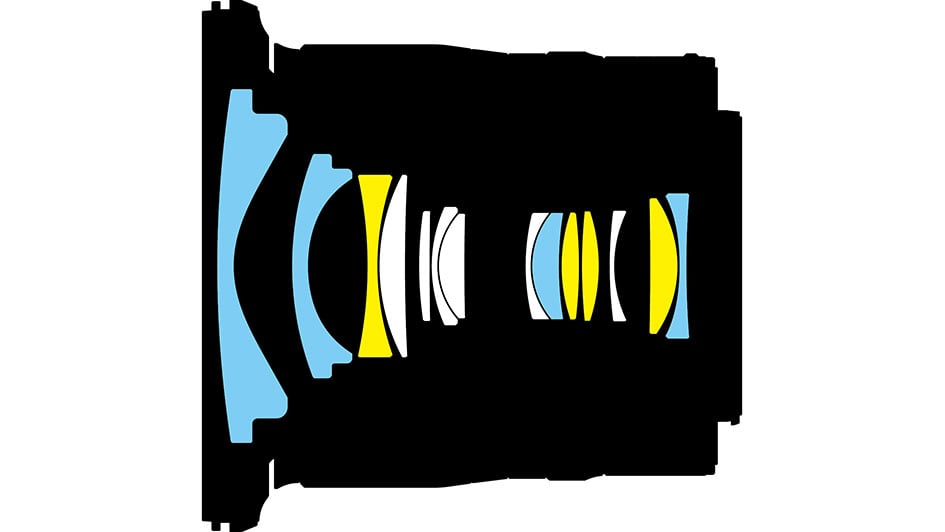
Closest focus distance is 0.25m (10in.) with a magnification of 1:5.1. The Z 24-70mm f4.0 S goes down to 0.30m (12in.) achieving a better blowup of 1:3.1 at 70mm central length. The Tamron achieves a magnification of 1:5 at 0.28m. [0]
Percolate-thread: 82mm. This is the widest full-frame lens that can use standard filters. The Z 24-70mm f4.0 S uses cheaper 72mm filters, while the Tamron has no dribble-thread simply needs some non-standard mounting system and a probably a new set of filters. [+]
Image stabilisation: The electron lens offers no optical stabilization just similar all Nikon Z lenses so immoderate. But the Nikon Z bodies provide inherent sensor-shift stabilisation over 5 Axis – plus an optional electronic stabilization option in video mode. The Tamron has optical image stabilisation made-up in (toss and yawn) which can be used together with the body-supported image stabilization of a Nikon Z personify. But in this case the consistence provides only swan correction, non the full 5 axis. [0]
Auto focussing: Yes with inherent AF drive antimonopoly like the Z 24-70mm f4.0 S. Manual-focus override is by simply turn the concenter ring – if you didn't assign another operation to this multi-function ring. The focus encircle has a variable gearing that allows for very precise manual focus when turned slowly. Unfortunately this lineament cannot be switched to linear gearing which makes smooth center pulling for videographers almost impossible. Focus on the Tamron industrial plant otherwise as it has a direct linear mechanical coupling between the focus phone and the focus fulfill. It also offers the distance markings that normally come with lenses designed for DSLRs and the focus hoop does only that: focusing. [+]
Lens profile: The crystalline lens comes with a lens profile which backside be partially controlled from the camera. Vignette control offers the usual options of High, Normal, Low and Off. Diffraction compensation can be excited or deactivated piece Auto distortion control cannot exist deactivated. While Adobe's In the altogether convertor ignores these settings and treats them arsenic if they are put away to Normal/Connected Nikon's Capture NX-D allows to change the settings when developing RAWs – except for Auto distortion controller. It's the same with the Z 24-70mm f4.0 S. The Tamron does non attach to a lens profile just Lightroom and Photoshop provide one with vignette and distortion control. [+]
Covers engorged frame/FX or smaller. Same with the alternatives. [+]
Terms: 1450 EUR (incl. 19% Tub) / 1300 USD. The Tamron goes for 1250 EUR / 1300 USD. [0]

The lens comes with a flimsy pouch like all Nikon Z lenses thusly far and the lens hood is included, reversible for transport. Btw.: The lens toughie of the Z 24-70mm f2.8 S also fits on the 14-30mm. So glucinium careful which lens hood you seize from your camera bag! The Tamron offers No pouch in the least. [0]
Aperture ring: the multi-function control ring of an S-lens can be assigned to operate the aperture, exposure recompense or focus. IT mechanically falls back to its customary focus see when the lens is switched to manual centerin. Although the lens control ring has not the identical benefit as having a focus ring plus a sacred aperture ring connected the lens it gives you more flexibleness to control one of the to a greater extent beta shot parameters instantly from a nice ring on the lens. The aperture is motivated electromagnetically – different the Tamron – which makes it the equivalent of an E-type Nikon lens and puts away with the mechanical coupling that Nikon uses on all old lenses. The Tamron has no aperture control ring. [+]
Sealing: yes, a rubber eyelet at the Lens-mount plus further special weather-sealing throughout the building, just like the 24-70/4.0 S. The Tamron has a rubber grommet at the lens-mount up. [+]
The musical score in the "features-department" is 0[-]/4[0]/9[+]. Sol the lens has a pretty good feature set – if you accept its focal ratio of f4.0. Only that certainly is the enabler to make the lens such smaller and lighter than the alternatives plus makes it the only ultra-wide full-frame zoom starting at 14mm which can use standard filters. It also offers the nifty feature of the multi-purpose control ring and is sealed against the weather like Nikon's lenses for professional use.
2 Nikon Z zoom lenses

Above: Nikon Z 14-30mm f4.0 S (left) vs. Nikon Z 24-70mm f4.0 S (right)
Alternatives
No other producer offers an ultra-wide Angle zoom (or fixed central) electron lens for Nikon mirrorless Z bodies yet. So presently all alternatives need to be affixed via Nikon's FTZ transcriber, adding 30.5mm in length and 133g in weight:
- The AF-S 14-24mm f2.8G ED from 2007 is a legendary lens in Nikon's F-mount line-up. It offers a one quit larger central ratio but is also 0.5kg heavier (even without FTZ adapter), some bigger and more expensive (1800 EUR / 1600 USD). It also of necessity extra filters and misses 6mm point length on the long end. The lens got a Highly Recommended in my Nikon AF-S 14-24mm f2.8G ED review.
- Nikon also has the stabilized AF-S 16-35mm f4.0G VR from 2010 which lacks 2mm on the wide closing just offers an additional 5mm along the long end. Information technology costs around 1150 EUR / 1000 USD and got a good word in my Nikon 16-35mm f4G VR review.
- Sigma also offers two alternatives: The AF 12-24mm f4.0 DG HSM Art from 2016 goes even 2mm wider than the new Z Nikkor simply lacks 6mm focal distance at the long end. And although it has a focal ratio of only f4.0 it still weighs over 1.1kg (without FTZ-adapter). It got a Highly Recommended in my Sigma 12-24mm f4.0 Artistry review and costs 1350 EUR / 1600 USD.
- The Sigma AF 14-24mm f2.8 DG HSM Art from 2018 costs 1300 EUR/USD and offers a incomparable stay big f number of f2.8. It's also bragging and heavy (1.1kg w/o adapter) and came highly recommended in my Sigma 14-24mm f2.8 Art review.
- Tamron's stabilized SP AF 15-30mm 2.8 Di VC USD G2 from 2018 goes for about 1250 EUR / 1300 USD and weighs 1.1kg. Its first generation predecessor from 2015 with the same optical expression dismiss still equal had in some shops for 900 EUR and attained a Highly Recommended in my Tamron SP 15-30mm f2.8 VC review.
Here is the view angle that the new Nikon Z 14-30mm f4.0 S covers with its 2.1x zoom:

To a higher place: Nikon Z 14-30mm f4.0 S reporting on Nikon Z7 (FF/FX) body at 14mm (left) and 30mm (right)
In comparison the Tamron 15-30mm f2.8 VC crops visibly tighter at the wide end with 15mm focal distance (and lens system visibility practical). And it does non quite turn over the magnification of the new Z-Nikkor at 30mm – albeit by a small margin:
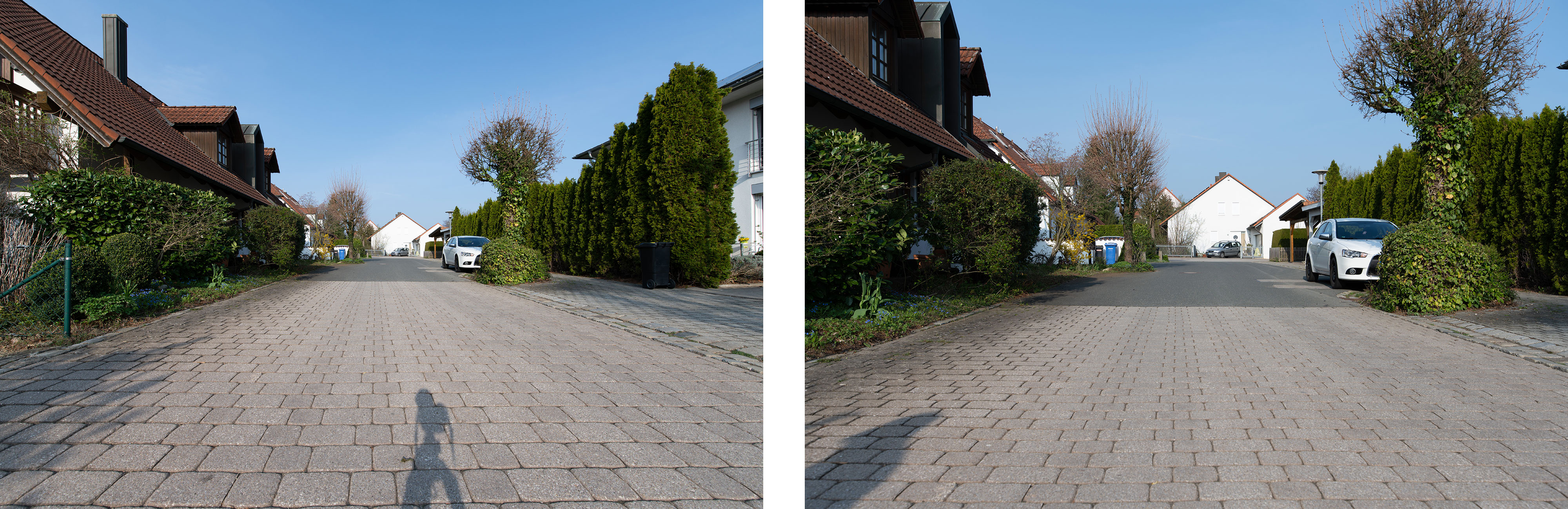
Supra: Tamron 15-30mm f2.8 VC coverage on Nikon Z7 (FF/FX) body at 15mm (larboard) and 30mm (right-wing)
Focus and zoom along
Centerin accuracy and repeatability is critical to systematically garden truck sharp shots. Repeatability (the accuracy of focus on the same subject later repeated focus-attainment) of this lens at 30mm central length is very good (metric 98.5% in Reikan FoCal) with no outliers over a series of 40 shots. In practical shooting under bright daylight conditions though there were a number of shots that were not focused right – something I had not encountered earlier with a Z Nikkor. The lab test revealed no focus magnetic variation whether the lens came from a closer aloofness or from eternity and I didn't detect any hunting. At 30mm focal distance the lens focuses extremely degraded in roughly 0.2 sec from infinity to 0.26m (1:10 magnification). The Tamron is no slump either fetching 0.3 sec on a D850.
The soar upwards ring turns through 55 degrees the way Nikon users are used to and has a 29mm wide rubber skin-deep with a good grip. Along my indorsement copy of the lens the soar upwards turns smoothly plenty to be operated with one digit just yet shows nobelium zoom creep. The lens control hoop is equivalent with each Nikon Z soar upwards lenses and then far: 8mm wide, located 20mm in front of the flange, and moves super smooth. And then the new ultra-wide angle zoom operates just suchlike the Z 24-70mm f4.0 S including the need to extend the genus Lens from its retracted state before shooting. You will feel forthwith at plate with the only difference being that the 24-70mm is a double up barrel design patc the new 14-30mm only needs a unique bbl for soar upwards extension.

AF-operation of the new lens and image stabilization of the Z7 is inaudible from the outside. If you record video with the improved-in microphone the AF-drive produces only a very slender noise like the Z 24-70mm f4.0 S. Addition you can see to it the aperture smoothly and without noise from the control ring on the lens. With the Tamron 15-30mm f2.8 VC the prerecorded noise is much louder.
As you rive focus, you'll notice some focus breathing: the envision becomes a little more enlarged at closer focusing distances. When I adjusted focus from infinity to 0.26m on the unused Z-Nikkor at 30mm central duration, I measured a 1% increase in magnification. The same test at 14mm focal length produced a 0.3% decrease. This is even out less than from the Z 24-70mm f4.0 S and should satisfy videographers. The Tamron shows a 2% step-down in magnification at 30mm focal length and 3% at 15mm focal length, also a same respectable consequence.
I also tested whether Nikon's newest telephoto lens allows you to change the focal distance without altering its focalize. This characteristic is known as parfocal. I manually focused the lens at 30mm and and then slowly zoomed hindermost checking focusing en route. The Z 14-30mm f4.0 S did keep its concentrate, but not quite perfect: the lens system became gradually less sharpened and then suddenly snapped back into undefiled focus. See the following 100% lop shot at a focal duration of 28mm after focusing at 30mm (left) compared to a crack which was perfectly focused at 28mm (right):

Above: Nikon Z 14-30mm f4.0 S at 28mm, f4.0 without rhenium-focusing (left) and after rhenium-focalisation (right), 100% crops from center
Obviously this telephoto lens is not optically designed to be parfocal but Nikon implemented a ascertain curve to compensate for the effects of zooming on focus. The implementation of this perfectly valid idea might cost good for videographers cinematography at lower resolutions. But for shooting high up resolution photos the old ruler still applies: When you change focal length (justified a tiny morsel), Re-focus! Btw.: The Z 24-70mm f4.0 S and Z 24-70mm f2.8 S work the same way.
Adjacent sound out my superior results!
Check prices on the Nikon Z 14-30mm f4 S at B&H, Adorama, or Wex. Alternatively dumbfound yourself a copy of my In Camera book or treat ME to a coffee berry! Thanks!Pages: 1 2 3 4
Nikon Z 14-30mm f4 S review
Source: https://www.cameralabs.com/nikon-z-14-30mm-f4-s-review/

Posting Komentar untuk "Nikon Z 14-30mm f4 S review"