a deviation iq is an iq score based on
Presentation to IQ
IQ is a type of standard score that indicates how far above, Beaver State how far below, his/her compeer grouping an individual stands in mental power. The peer radical score is an IQ of 100; this is obtained by applying the same try to huge numbers pool of people from completely socio-economic strata of society, and taking the modal.
The term 'IQ' was coined in 1912 by the psychologist William Stern in relation to the German term Intelligenzquotient. At that time, Intelligence quotient was delineate as a ratio of mental mature to written record age x 100. So, if an independent of 10 years of age had a mental age of 10, their IQ would be 100. However, if their rational age was greater than their written account age (e.g., 12 rather than 10), their IQ would be 120. Similarly, if their mental age was turn down than their written record geezerhoo, their IQ would be lower than 100.
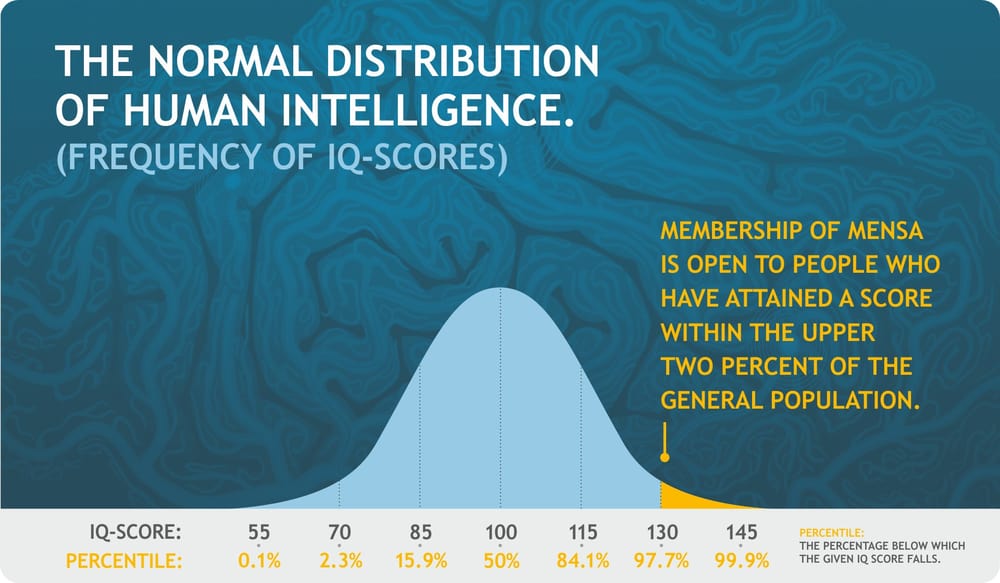
When current IQ tests were improved, the normal score of the norming sample was circumscribed as IQ 100; and standard deviation (a applied math concept that describes average dispersion) up or down was defined A, for example, 16 or 24 IQ points greater surgery less than 100. Mensa admits individuals who score in the uppermost 2% of the universe, and they accept many different tests, as long as they have been standardised and normed, and approved past professional psychologists' associations. Two of the most well-renowned IQ tests are 'Stanford-Binet' and 'Cattell' (explained in Thomas More detail below). In practice, qualifying for Mensa in the top 2% means scoring 132 or more in the Stanford-Binet run, or 148 or more in the Cattell equivalent.
Measuring Intelligence - Noteworthy Contributors
Sir Francis Galton
Sir Francis Galton was the inaugural man of science World Health Organization unsuccessful to devise a modern test of intelligence in 1884. In his open science laborator, people could undergo the acuity of their vision and audience measured, every bit well as their reaction times to antithetic stimuli.
James McKeen Cattell
The world's first body part essa, created by James McKeen Cattell in 1890, consisted of similar tasks, almost wholly of them measuring the pep pill and accuracy of perception. It soon turned out, even so, that such tasks cannot predict academic accomplishment; therefore, they are probably imperfect measures of anything we would call intelligence.
Alfred Binet
The first modern-day IQ test was created by Alfred Binet in 1905. Unlike Galton, he was not inspired by scientific enquiry. Rather, he had really pragmatical implications in mind: to be capable to key children who cannot retain up with their peers in the educational organization that had recently been ready-made compulsory for all.

Binet's screen consisted of knowledge questions as well American Samoa ones requiring simple reasoning. Besides mental test items, Binet also needful an external criterion of validity, which he constitute in age. So, even though there is substantial variation in the pace of development, older children are generally more cognitively front than jr. ones. Binet, consequently, identified the mean age at which children, happening median, were capable of resolution each item, and categorized items accordingly. This way he could estimate a children's view proportional to their peers: if a child, for exemplify, was capable of solving items that were, connected average out, only solved by children WHO were two years older, then this child would comprise two years ahead in mental development.
William Stern
Subsequently, a much veracious draw close was planned by William Stern, who suggested that instead of subtracting real age from the age estimated from test carrying into action, the latter (termed 'noetic age') should be divided by the former. Thence the famous 'intelligence quotient' or 'IQ' was hatched and defined as (mental age) / (chronological age). It so clad that such a reckoning was more eligible with other estimates of mental carrying into action. For instance, an 8-year-sexagenarian performing on the level of a 6-class-old would arrive at the one appraisal low Binet's system every bit a 6-year-erstwhile performing along the level of a 4-yr-old. Yet, in Stern's system, the 6-year-old would get a lower score American Samoa 4/6 < 6/8. Know shows that when they both turn of events 10, the right away 8-class-old is more likely to outperform the now 6-year-erstwhile in psychological feature tasks; hence Stern's method proved to be more valid.
Lewis Terman
It was in the US where IQ testing became a real success story after Lewis Terman revised Binet's test, creating a often more earmark average than the original, and he promulgated it as the Stanford-Binet exam (Terman was a psychologist at Stanford University). He was also keen to multiply the issue by 100, so the final equation for IQ is (mental age) / (chronological long time) X 100. So, an IQ of 130 sounds so much cooler than an IQ of 1.3.
This method acting, however, only works well in children. If a child's parents were told that their 6-year-gray already had the mental capabilities of an average 9-year-old and, therefore, his or her IQ was 150, they would be over the lunar month. But if the child's grandfather was told that even though helium was exclusively 60, his cognitive abilities were on a par with the average 90-yr-old, he might not take it Eastern Samoa a compliment. Obviously, the quotient only whole kit and caboodle as long as Alfred Binet's original criterion is functional; i.e., as long as older age in the main agency better abilities. Put differently, the method acting is unsuitable when psychological development does not take place some many.
Saint David Wechsler
David Wechsler solved the problem of calculating grown IQ by simply comparing performance to the statistical distribution of test loads, which is a normal distribution. In his system of rules the IQ of those whose grudge equalled the mean of the age mathematical group was 100. This way the IQ of the median adult would be 100, just the likes of the IQ of the average child in the original system. Atomic number 2 exploited the applied math properties of the normal distribution to put IQ scores supported the extent of the coevals one outscored. For instance, someone whose score was one standard deviation above the ignoble, and WHO therefore outperformed 86% of his or her contemporaries, would have an IQ of 115, then on.
IQ Tests Nowadays

So, why is it known as 'IQ', a quotient, if nothing gets divided? The hastate reason is that the concept of IQ had become too touristy for the term to be thrown-away. Even out so, it is interesting to note that in adults it is not really a quotient at all: it is an meter reading of how well one and only performs on mental tests, compared to others. Besides extending the construct of IQ, another star interfere the development of IQ examination was the creation of grouping tests; ahead this, people had been individually tested by qualified psychologists. The first group test was created for the US U. S. Army, but they soon spread to schools, workplaces and beyond, becoming one of psychology's sterling popular successes, and remain and so to this day.
a deviation iq is an iq score based on
Source: https://www.mensa.org/iq/what-iq

Posting Komentar untuk "a deviation iq is an iq score based on"